Every institution leadership team has had some version of the same conversation in the past eighteen months: "We should be doing something with AI." The ambition is real. The use cases are obvious — faster marking, always-on student support, personalised feedback at scale. The problem is the gap between recognising the opportunity and actually deploying something that works, that staff trust, and that doesn't put student data at risk.
Most institutions are still stuck in that gap. They've run pilots. They've had staff experiment with general-purpose AI tools. They've read the reports. But production-grade AI agents — the kind that actually sit inside the learning environment, handle real submissions, and deliver results to real students — are still rare outside of well-resourced research universities with dedicated AI teams.
That's what Kampus Sense is designed to change.
The Adoption Gap in Education AI
The education sector isn't short of AI enthusiasm. It's short of AI infrastructure — the operational layer that connects AI capability to the actual workflows institutions run every day: marking, revision support, student Q&A, content delivery.
General-purpose tools like ChatGPT are widely used by students and staff alike, but they aren't connected to the LMS, don't know the course content, can't access the rubric, and aren't accountable to the institution. The answers they give are plausible but ungrounded. They can't be audited. And they introduce student data handling questions that most institutions are not yet equipped to answer.
On the other end of the spectrum, building custom AI infrastructure from scratch — your own vector stores, your own API integrations, your own marking pipelines — requires a specialist engineering team that very few institutions have, and even fewer want to maintain.
The result is a capability gap that is getting wider as AI improves, not narrower.
"The institutions that will define best practice in educational AI over the next five years are not the ones waiting for a perfect solution. They are the ones building repeatable, auditable AI workflows into their existing systems now."
What an AI Agent Actually Does in an Educational Context
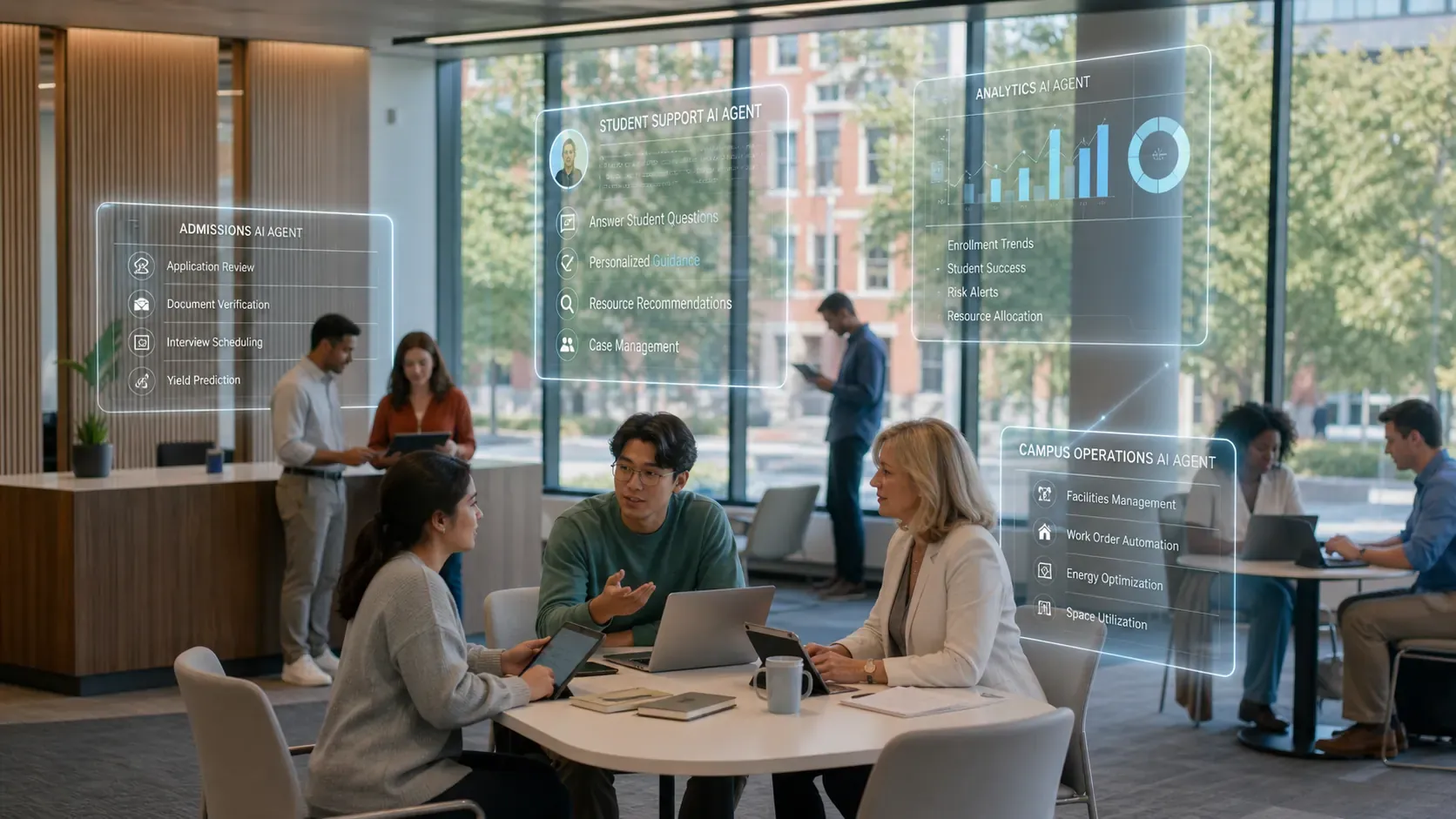
The word "agent" is used loosely in most AI discussions. In an educational context, a useful definition is: an AI agent is a configured, task-specific AI that operates on your institution's data, follows your institution's rules, and produces auditable outputs inside your institution's environment.
That distinction from a general chatbot matters enormously in practice.
An exam auto-marker doesn't just evaluate text — it marks against your rubric, returns per-student scores with structured feedback, flags low-confidence submissions for lecturer review, and holds results in a queue until a human approves them. It knows the difference between a correct but poorly-worded answer and a genuinely wrong one, because it has your rubric, not just a general understanding of the subject.
A pre-seen tutor doesn't just answer questions about the exam topic — it answers questions grounded in your pre-seen case study, refuses to reveal model answers or exam tasks, and operates within configurable session limits. Students get accurate, grounded help at 2am the night before the exam. The institution doesn't need to staff a helpdesk for it.
A module summariser doesn't summarise the internet's version of the topic — it summarises your course content, in English, Sinhala, or Tamil, mapped to your stated learning objectives. Students with different language backgrounds get the same course content made equally accessible.
These are not theoretical capabilities. They are production workflows that institutions can deploy today — without building anything from scratch.
The Control Problem: Why Institutions Have Been Right to Be Cautious
There's a reasonable explanation for why institutions have been slow to move beyond experimentation: the available AI tools have not offered the governance controls that regulated, accreditation-sensitive environments require.
For AI to be deployed in assessment — arguably the most consequential workflow in any institution — three things have to be true. The marking process must be auditable. Human reviewers must be able to intervene before results reach students. And student data — answer papers, submissions, personal information — must not leave the institution's controlled environment.
Most general AI tools fail all three tests. They are not auditable in the way accreditation bodies expect. They don't have a concept of a lecturer approval queue. And they are SaaS products that process data on infrastructure owned by someone else.
This is why Kampus Sense was built with a specific architecture: all production AI execution runs inside the institution's own Moodle LMS via a dedicated plugin. Answer papers and student submissions never leave the institution's server. The Kampus platform handles configuration, analytics, and billing — not data. The institution's own OpenAI API key processes the AI workloads, making token costs fully transparent and the AI provider relationship direct, not intermediated.
Human-in-the-loop approval is not an add-on. It is part of the default configuration. Lecturers review AI-generated marks before they are released. Low-confidence submissions are automatically held for manual review regardless of the automation setting. The audit trail — who approved what, when, and on which submission — is part of the record.
Introducing Kampus Sense: Build Any Agent Your Institution Needs
Kampus Sense is the AI agent platform inside Kampus Suite. It gives institutions the ability to build, configure, and deploy AI agents connected to their LMS — without writing any AI infrastructure code, and without a specialist AI team.
The platform ships with seven pre-built agent types that cover the most common educational AI workflows: exam marking, personalised debrief reports, module summarisation, pre-seen tutoring, timed mock exams, and student FAQ bots. Each is configured through a guided, no-code wizard that any lecturer or IT administrator can operate from a browser.
But the capability that sets Kampus Sense apart for institutions with specific requirements is the Custom Agent Builder.
Build once, deploy to any cohort
The Custom Agent type starts from a blank canvas: define the agent's purpose, upload its knowledge base, configure its prompt behaviour, and set its output format. There is no template to work around and no pre-defined structure to adapt. If your institution runs a unique professional programme, hosts a specialist body of content, or has a teaching methodology that doesn't map neatly to the pre-built types, the custom agent is built for that gap.
Custom agents are managed through the same platform as pre-built types — the same approval workflow, the same usage analytics, the same cost dashboard, the same RBAC model that controls which lecturers manage which agents. A custom agent built for one programme doesn't create a separate system to maintain. It sits alongside your exam markers and revision tutors as part of a single operational layer.
One installation. Every agent your institution needs.
Once the Moodle plugin is installed and the institution's OpenAI API key is connected, every agent type — existing and future — becomes available through the same interface. There is no new integration required when a new agent type is released. There is no separate contract per use case. The platform is the infrastructure layer; the agents are the applications that run on top of it.
This is the architectural logic that makes Kampus Sense categorically different from point solutions. Institutions that buy a standalone AI marking tool end up with a standalone AI marking tool. Institutions that deploy Kampus Sense end up with an extensible AI operations layer that they own, that runs on their infrastructure, and that grows with their curriculum.
What This Means for Directors and IT Teams
The decision to deploy educational AI sits differently for directors and IT managers, and Kampus Sense was designed to satisfy both.
For institution directors, the governance case is clear: configurable approval workflows, full audit trails, and LMS-native execution mean AI can be deployed in assessment without compromising the institution's accreditation position or its obligations to students. The BYOK model means no surprise AI costs — institutions pay OpenAI directly, with full token-level visibility in the platform dashboard.
For IT managers, the operational case is equally clear: a single Moodle plugin installation, OAuth 2.0 / OIDC SSO through the Kampus identity layer, and per-tenant database isolation mean Kampus Sense fits into existing infrastructure rather than requiring parallel systems. There is no AI infrastructure to manage. There are no vector store pipelines to maintain. When OpenAI releases a new model, it becomes available to every agent on the platform — configuration only, no code changes.
We've Launched. Here's What's Next.
Kampus Sense is now available as part of Kampus Suite. Institutions can onboard, configure agents, and begin deploying within days of plugin installation.
Read the full launch announcement on our homepage →
If you are evaluating AI capabilities for your institution — whether for assessment, student support, or content delivery — we're offering a guided walkthrough of the platform with a live agent demonstration. No slides, no concept decks. A working exam marker, a working revision tutor, running against real course content.
Request a demo → kampuscloud.com/contact
Kampus Sense is part of Kampus Suite — a platform built specifically for educational institutions in Sri Lanka and the region. Learn more at kampuscloud.com.