Why Multi-Campus Institutions Outgrow Their SIS — and What to Do About It
Multi-campus growth is a milestone worth celebrating — until you log into your student information system and realise it was never designed for more than one site. At that point, every new campus you add quietly multiplies your administrative burden, your data inconsistencies, and your IT overhead. If you're managing two or more campuses today and your SIS is making it harder rather than easier, this post is for you.
The Multi-Campus Problem No One Warns You About
Most student information systems are built with a single institution in mind. When a college or university expands to a second or third campus, the typical response is to work around the SIS rather than through it: a shared spreadsheet for the second campus here, a duplicate database entry there, a custom report that aggregates data from two different exports every Monday morning.
The result is a system that technically works — until it doesn't. A student who transfers between campuses appears in two records. A fee plan configured for one site doesn't apply correctly at another. Timetable planners at each campus can't see each other's room bookings, so conflicts aren't caught until staff are already heading to the same room at the same time.
None of these problems are inevitable. They're symptoms of a platform that wasn't built for multi-site operations from the ground up.
Five Signs You've Outgrown Your Current SIS
1. You Manage Multiple Spreadsheets or Shadow Systems Per Campus
When your SIS can't natively distinguish between campuses, staff improvise. You'll find a spreadsheet for campus B's intake cohort sitting in someone's OneDrive, a separate finance template for the satellite site, and an ad-hoc process for anything that involves students moving between locations. Every one of these shadow systems is a future reconciliation headache.
2. Fee Structures Are Different Across Sites — and You Can't Enforce It Automatically
Multi-campus institutions routinely run different fee models at different sites — different tuition rates, local levies, campus-specific services. If your SIS can't define and apply campus-based pricing rules natively, your finance team is manually adjusting invoices every cycle. That's not a workflow — it's a risk.
3. Timetable Planning Is Done in Isolation Per Campus
When room bookings, staff availability, and session schedules aren't shared across campuses in a single system, planners at each site are flying blind. Visiting lecturers get double-booked. Rooms appear available in the system but are in use. Students in cross-campus programmes have no coherent schedule view.
4. Student Transfers Between Campuses Break Your Records
A student who moves from your city campus to your regional campus mid-year should have one continuous academic record. If your SIS creates duplicate enrolment records, loses historical fee data, or requires manual re-entry of academic history, it's telling you something important: it doesn't support the student lifecycle as a single, continuous thread.
5. Reporting Requires Exporting and Merging Data Manually
If the only way to get an institution-wide enrolment figure is to export a CSV from each campus's SIS instance and merge them in Excel, your platform is generating work rather than eliminating it. Institutional leaders need consolidated visibility without custom queries or manual aggregation every time they need a number.
What a Multi-Campus SIS Should Actually Do Differently
Fixing these problems isn't about buying more licenses or adding integrations. It requires a platform built on different architectural assumptions — one where multi-campus operation is a first-class concern, not a bolt-on.
Campus and Room Management as Core Infrastructure
A purpose-built multi-campus SIS lets you register every campus as a distinct organisational unit, with its own buildings, rooms, room features (capacity, AV equipment, accessibility), and availability rules — all within one system. Kampus Axis models this natively: campuses, rooms, and room features are configured once and flow directly into timetable scheduling, so planners at every site are working from shared, accurate data.
Campus-Based Fee Plans Without Manual Overrides
Kampus Axis supports 11 distinct fee structure types in a single unified fee plan engine — including campus-based pricing. That means you configure a fee rule that charges a different rate depending on which campus a student attends, and the system applies it automatically at the point of invoice generation. No manual adjustments, no per-campus spreadsheet, no finance staff manually checking which site a student is enrolled at before issuing an invoice.
Other fee structure types include programme-based, intake/batch-based, term-based, instalment plans, per-module fees, per-credit-hour fees, delivery-mode pricing, and student-category pricing — all supported in one model, not separate schemas that have to be reconciled.
Timetable Planning with Cross-Campus Conflict Detection
When rooms, staff, and cohorts are all registered in the same system, conflict detection becomes genuinely useful across the whole institution. Kampus Axis detects staff clashes, room double-bookings, and cohort time conflicts before a timetable is published — whether those clashes are within a single campus or across sites. Timetables are planned in draft mode and published when ready, so students only ever see a finalised, conflict-free schedule.
Delivery Mode Management for Blended Institutions
Multi-campus institutions are increasingly multi-modal: some students attend on-campus at one site, others are in hybrid or fully online delivery, and the mix may vary by programme or term. Kampus Axis lets you define delivery modes (on-campus, online, hybrid, and others) that flow through programme configuration, fee plans, and the student portal — so the system accurately reflects how your institution actually delivers education, not a simplified single-mode model.
Role-Based Access Across Campuses
Not every staff member should see data from every campus. A campus administrator in one city should be able to manage their students, rooms, and schedules without seeing sensitive financial records from another site. Kampus Axis implements granular role-based access control (RBAC) system-wide, so institutional leaders can configure exactly who sees what — giving each campus the autonomy it needs while maintaining central oversight.
One Student Record, Regardless of Campus Transfers
Enrolment lifecycle management in Kampus Axis supports campus transfers as a structured change workflow — not a manual re-entry process. When a student moves from one campus to another, their academic history, financial record, and enrolment state move with them cleanly. The same applies to module swaps, programme transfers, and curriculum period advances: every change flows through a structured process that keeps the record accurate and traceable.
The Hidden Cost of the Multi-Campus Workaround
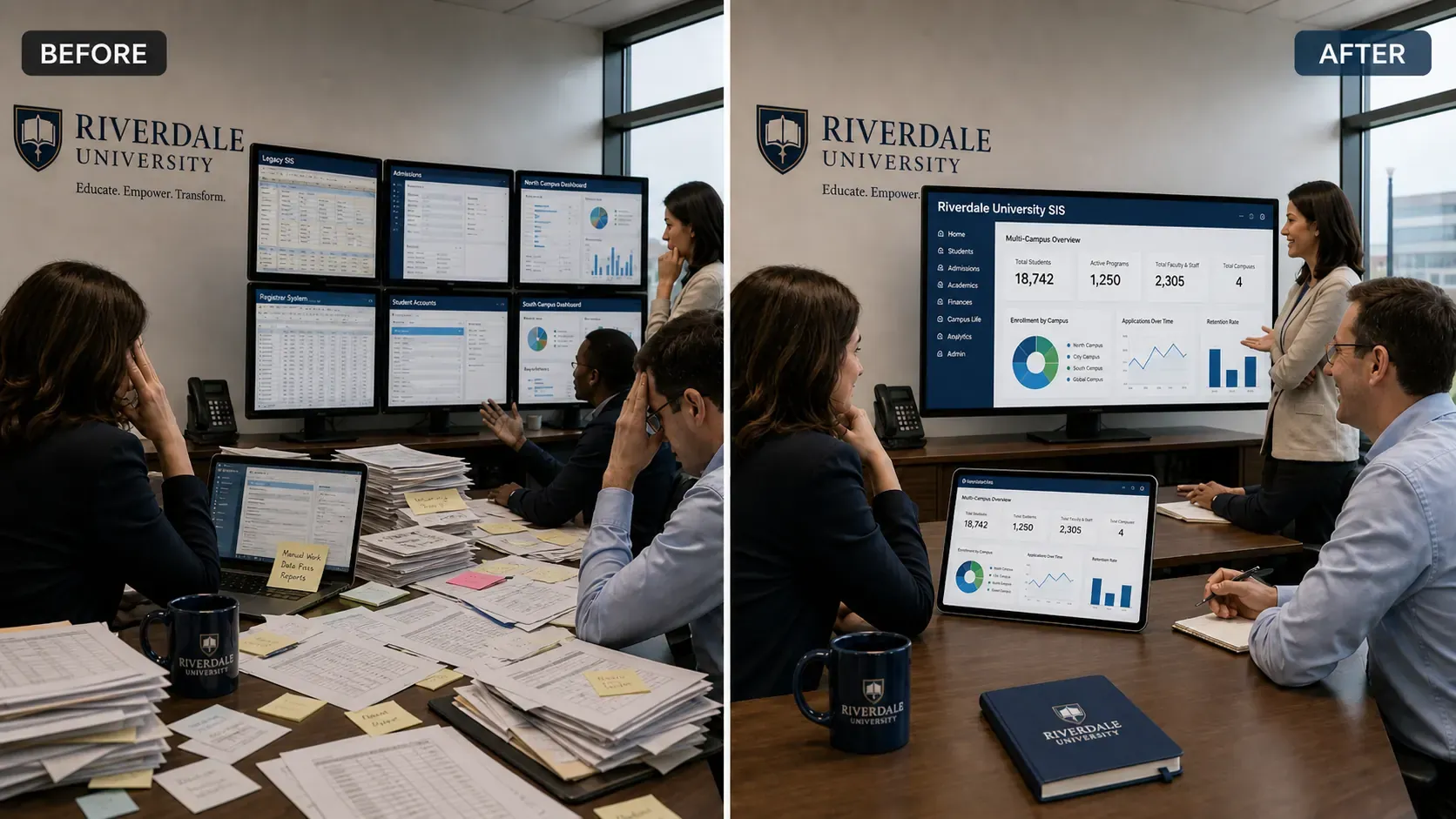
It's tempting to treat the workarounds as manageable. After all, the spreadsheet for campus B has been working for two years — why change it now? The answer is that workarounds compound. Every new campus, every new cohort, every new fee structure makes the manual reconciliation work a little harder. The hidden cost isn't in any single process; it's in the cumulative overhead that keeps growing while your institution scales.
A single source of truth across campuses doesn't just save time — it eliminates an entire category of errors. When admissions, finance, and academic records all live in one system, there's no syncing, no cross-referencing, and no "which version of this data is correct?" conversation. That's not an incremental improvement over a patchwork of systems; it's a fundamentally different operating model.
What to Look for When You're Ready to Switch
When evaluating a replacement SIS for multi-campus operations, the questions that matter most are rarely on the feature checklist:
- Does campus-based fee configuration work natively, or does it require workarounds? Ask for a live demonstration of a campus-based fee plan being applied at invoice generation.
- Can timetable conflict detection operate across campus boundaries? A system that detects conflicts within a campus but not across sites will leave your multi-modal operations unprotected.
- Is role-based access granular enough for your organisational structure? Generic admin/read-only permission models rarely match the nuanced access needs of a multi-campus institution.
- What happens to a student's record when they transfer between campuses? The answer should involve a structured workflow, not a workaround.
- Is the system built on a single data model, or is it multiple systems with an integration layer? Integration layers introduce sync failures; a single data model doesn't.
Conclusion
Outgrowing your SIS is a problem that doesn't announce itself loudly. It shows up as a spreadsheet that's getting harder to maintain, a finance process that's slower than it should be, a timetable planning cycle that requires more calls than it used to. By the time the operational cost is obvious, the technical debt is already significant.
Kampus Axis was built for institutions that operate across multiple campuses, delivery modes, and fee structures — without requiring you to adapt your operations to fit the software. Campus management, cross-campus conflict detection, campus-based pricing, and RBAC are all first-class features, not add-ons.
If your current SIS is showing the signs above, now is the right time to evaluate your options before the next intake cycle compounds the problem further.
See how Kampus Axis handles multi-campus operations in a live environment. Request a Demo and we'll walk you through exactly how the platform handles your institution's specific setup.