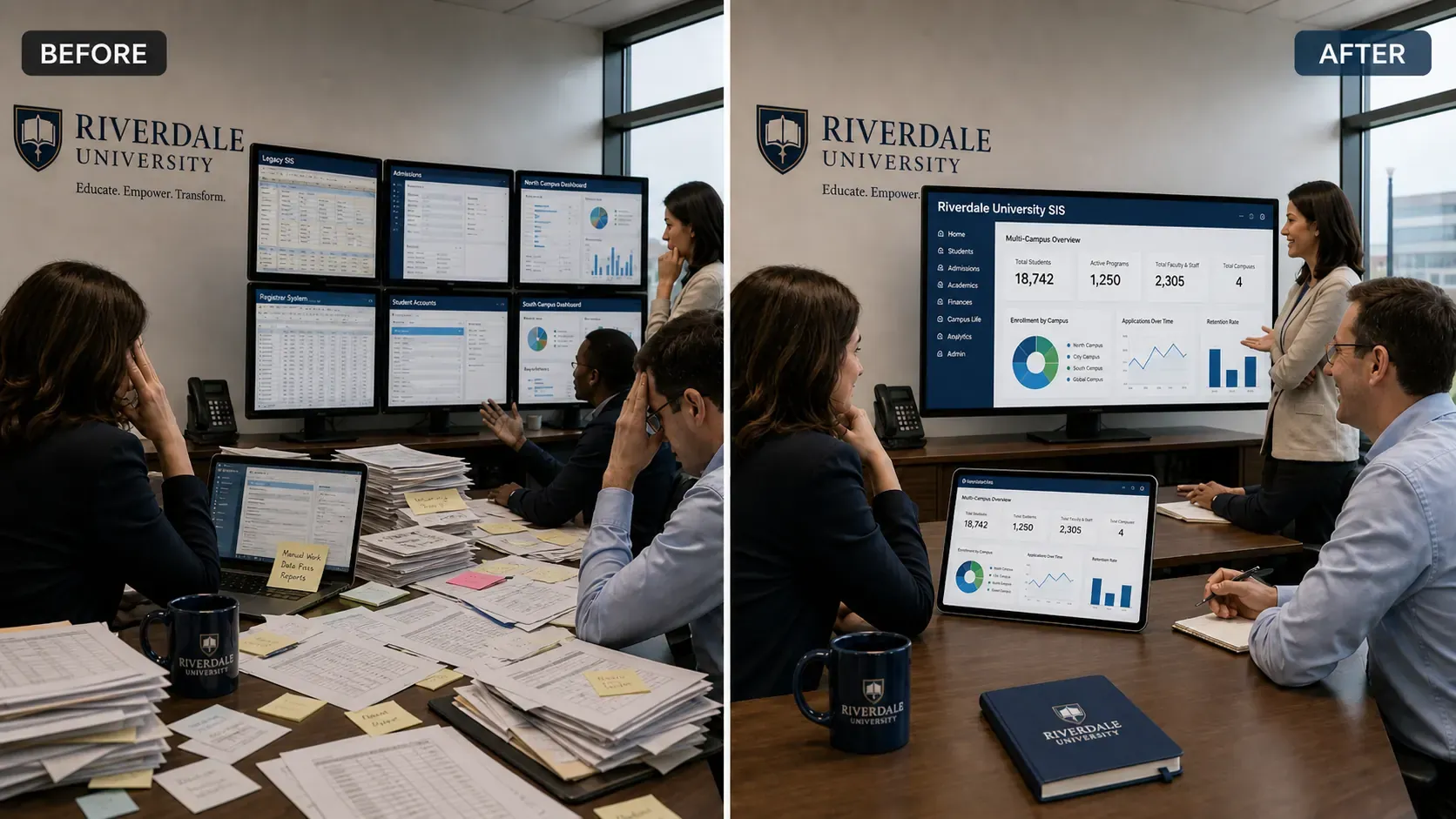

Ask any admissions manager how their team handles applications, and you'll hear a familiar answer: a shared inbox for enquiries, a spreadsheet to track progress, a separate finance system to chase fees, and an email thread somewhere in between for offer letters. It works — sort of — until it doesn't.
The real cost of stitching admissions together across multiple tools isn't just the staff hours lost to copy-pasting data. It's the offers that went out late because someone forgot to update the tracker. It's the student who paid a deposit into the wrong account because the payment link was buried in an old email. It's the institutional leader who asked "how many confirmed enrolments do we have this intake?" and got three different answers from three different departments.
This article breaks down exactly where those costs come from — and what a modern admissions management system looks like when everything is running from a single source of truth.
Why Admissions Is Uniquely Vulnerable to System Sprawl
Admissions is a cross-functional process. It touches marketing (who generates enquiries), academic administration (who sets intake criteria and programme availability), finance (who collects application fees and seat deposits), and IT (who provisions student accounts). When each department operates its own tool and communicates by email, every handoff is a potential data loss point.
Institutions usually arrive at this state incrementally. A spreadsheet is added to manage applications. A finance package is introduced to handle fee collection. An email marketing tool is plugged in to nurture leads. Each addition made sense at the time. But the cumulative effect is an admissions process that is harder to audit, slower to move, and more error-prone than anyone realises — because the errors are spread across systems rather than concentrated in one visible place.
The Hidden Costs — Mapped
The operational overhead of a fragmented admissions process doesn't appear on a single line in any budget. It's distributed across staff time, error recovery, delayed revenue, and reputation. Here's how it breaks down:
| Cost Area | What's Actually Happening | Business Impact |
|---|---|---|
| Manual data re-entry | Applicant data entered into one system, then manually copied into the finance system and the student record system. | Staff hours diverted from high-value tasks; transcription errors cause billing mistakes and duplicate records. |
| Delayed offer letters | Offer letters are drafted individually in Word, approved over email, and sent manually — or queued behind other staff tasks. | Students who receive slow responses accept offers elsewhere. Conversion rates drop. |
| Payment disconnected from admissions | Finance collects deposits independently, and updates the admissions tracker manually (or not at all). | Admissions staff don't know which students have paid; seats are held for non-paying applicants while genuine students are told intake is full. |
| No centralised pipeline visibility | Each staff member has their own view of "their" applications. No single pipeline view exists. | Applicants fall through the cracks. Reporting to leadership requires manual aggregation from multiple sources. |
| Audit and compliance gaps | Status changes are not timestamped. Offer history lives in individual email accounts. | Regulatory audits become painful. Disputes with students cannot be resolved from the record. |
| Bulk intake chaos | Processing a large cohort means individual rows in a spreadsheet, one action at a time. | Errors scale with volume. A mistake in bulk enrolment affects dozens of students simultaneously and takes days to unwind. |
Where Data Breaks Down — and Why That Matters More Than You Think
The most damaging failures in a fragmented admissions process are the ones that aren't immediately visible. A student who was issued an offer letter but never had their fee status updated in the finance system. An applicant who paid a seat deposit by bank transfer but whose application remains in "under review" because nobody checked the bank statement. A discount code applied in the admissions spreadsheet that never made it into the finance system.
These aren't exceptional failures — they're structural ones. When two systems hold related data independently, divergence is the default state, not the exception. Reconciliation becomes a recurring manual task, and the effort scales directly with intake volume.
The Compliance Dimension
Accreditation bodies and government regulators increasingly require institutions to demonstrate that their admissions processes are fair, documented, and auditable. When offer letters are sent from personal email accounts and status changes live in a shared spreadsheet, there is no defensible audit trail. That's not just an inconvenience — it's an institutional risk.
What a Unified Admissions Management System Actually Looks Like
An effective admissions management system doesn't just replace the spreadsheet. It connects the entire admissions process — application submission, review, offer, payment, and enrolment — into a single pipeline where every step is visible, timestamped, and attributable.
Concretely, that means:
- Applicants submit through a self-service portal — not via email — and their data is immediately available to every relevant staff member in a structured, searchable form.
- Applications move through a defined status workflow — draft, submitted, under review, offer issued, accepted, enrolled — with status changes logged automatically.
- Offer letters and payment links are generated and sent directly from the application record — no manual drafting, no separate email thread, no copy-paste.
- Payment is connected to admissions — when a deposit is received, the application record updates automatically. Finance and admissions are looking at the same data.
- Bulk enrolment is handled safely — upload a file, preview the result, then commit — with a rollback path if something is wrong.
- Every action is time-stamped and attributed — providing a complete, auditable history of every decision made on every application.
The Kampus Axis Approach
Kampus Axis was built around exactly this requirement: that admissions should not be a separate process living in separate tools. The admissions module is part of the same platform as finance, academic management, and the student record — which means data doesn't move between systems because it doesn't have to.
When an applicant submits through the Kampus student portal, their record is immediately visible in the admissions pipeline. Staff can review, progress through workflow stages, issue offers, apply discounts, and send payment links — all from the application record itself. When a payment is received through a connected gateway (Stripe, Paycenter Web, or Sampath Bank), it is recorded against the student's financial account, not in a separate finance system that has to be reconciled later.
For larger cohorts, Kampus supports bulk enrolment via a structured template with a preview step before applying — so a single intake of 200 students doesn't require 200 individual records to be updated by hand, and mistakes can be caught before they become student-facing problems.
Because Kampus Axis is a single platform, the question "how many confirmed, paid enrolments do we have for this intake?" has one answer, available instantly, to any staff member with the appropriate access level. The audit trail for every offer, every payment, and every status change is part of the same record — with no reconciliation required.
Making the Case for Change Internally
If you're an admissions manager or registrar reading this, you probably don't need to be convinced. You've lived these problems. The harder task is often making the case to leadership that the status quo is more expensive than the investment required to fix it.
A useful exercise: track, over one intake cycle, how many staff hours are spent on data re-entry, reconciliation between systems, and error recovery. Add to that any delayed enrolments or lost conversions that can be attributed to slow offer processing or payment confusion. Compare that figure against the cost of a platform that handles those things automatically. The calculation is usually less close than people expect.
Conclusion
Running admissions across email, spreadsheets, and disconnected systems isn't just inefficient — it's structurally expensive in ways that are easy to underestimate because the costs are distributed and largely invisible. Late offers, missed payments, hours of manual reconciliation, and compliance gaps don't appear on a single budget line, but they add up to a significant and ongoing cost that grows with every intake.
A modern admissions management system eliminates those costs not by automating a fragmented process, but by replacing fragmentation with a single, connected pipeline. When admissions, finance, and the student record live in the same platform, the data discrepancies that consume staff time and erode institutional trust simply stop happening.
See Kampus Axis in Action
Watch how the Kampus Axis admissions pipeline, fee engine, and student portal work together in a single platform — and what that means for your next intake cycle.
Request a Demo