Why Your Students Are Still Emailing Staff for Basic Information (And the Simple Fix)
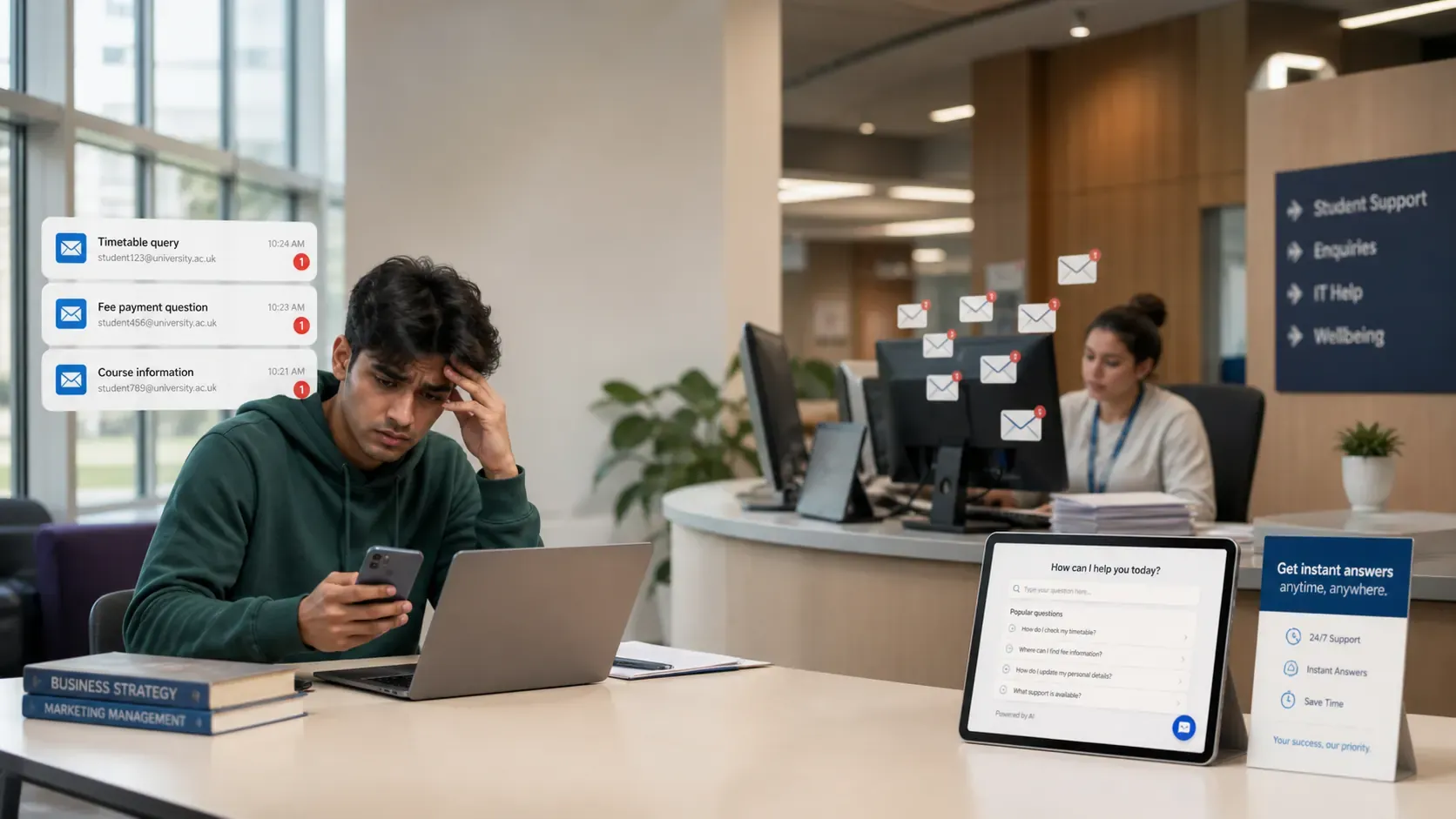
It's 9 pm on a Sunday night. A student needs to check their invoice before a payment deadline tomorrow. They can't find the information they need. So they do what students always do — they send an email. By Monday morning, your admissions officer has seven "can you send me my…" emails waiting before they've had their first coffee. If this sounds familiar, you're not alone. And the fix is simpler than you think.
The Hidden Cost of the Student Email Queue
Every time a student emails staff to ask for their timetable, their outstanding balance, their enrolment confirmation, or their application status, something goes wrong twice. The student is frustrated that they couldn't find what they needed. And the staff member who answers that email is now doing work that should have been self-service.
In institutions without a proper student self-service portal, this pattern repeats hundreds of times a week. Admissions staff spend hours responding to status queries. Finance teams field calls about invoice amounts that are already recorded in their system. Registrars resend timetable PDFs that change three times a term. The overhead compounds quietly, and because it doesn't show up on a single line in a budget report, it often goes unaddressed.
The real cost isn't just staff time — it's the quality of work being displaced. When your admissions officer is answering "what's my application status?" emails, they're not reviewing applications, improving processes, or supporting students who have complex needs that genuinely require human attention.
Why Students Keep Emailing (Even When You've Tried to Fix It)
Most institutions recognise the problem. Many have tried to solve it — with FAQ pages, notice boards, shared email inboxes, or static web portals that list general policies. These approaches don't work, because they miss the fundamental issue: students don't want general information. They want their information.
A student asking "what's my invoice total?" isn't looking for the institution's fee schedule. They want to see their specific account balance, with their specific fee plan applied, reflecting payments they've already made. A student asking about their timetable wants to see the sessions they are enrolled in — not a generic PDF of all module times.
When a self-service system can't give students access to their own data, the only remaining option is email. This is why so many institutions keep landing in the same place despite repeated attempts to reduce enquiry volume. The system doesn't know who the student is, or it doesn't expose the right information even when it does.
What a Student Self-Service Portal Actually Needs to Do
A self-service portal that genuinely reduces staff email load has four essential characteristics:
It knows who the student is. Authentication must be secure and frictionless. Kampus SIS uses OTP-based login for the student portal — students log in using a one-time code sent to their registered contact details, with no password to forget or reset. This removes one of the most common barriers to self-service adoption.
It shows real-time data from a live system. If the portal pulls information from a separate database that's synced once a day, students will see stale data and contact staff anyway. Kampus SIS is a single-system platform — the same database that processes payments, confirms enrolments, and generates invoices is the same database that the student portal reads from. When a payment is recorded, it's immediately visible to the student. When an offer is issued, the student sees it in their portal without waiting for a batch sync.
It lets students take actions, not just read information. View-only portals reduce some enquiry volume, but the bigger opportunity is in removing transactional emails entirely. With Kampus SIS, students can submit their application, pay application fees, and complete seat deposit payments directly through the portal — without emailing to get a payment link or waiting for a staff member to generate an invoice. The student self-service layer is connected to the same payment gateway infrastructure as the administrative system, which means transactions are processed and reflected accurately in both views.
It carries the institution's identity. A portal that looks like a generic third-party tool creates hesitation and distrust. Kampus SIS provides each institution with a branded student portal with custom domain support and organisation-level branding — including logo and colour customisation — so the portal feels like part of the institution, not an afterthought bolted on the side.
The Admin Side: Visibility Without the Chaos
Deploying a student portal shouldn't require handing off control to a separate IT system. With Kampus SIS, portal administration sits within the same admin interface used to manage enrolments, fees, and academic records. Portal domains, payment gateway connections, OTP login activity, and portal settings are all managed from within the SIS — without needing to touch infrastructure or involve a separate vendor.
This matters for institutions that have been burned by "integrated" tools that require their own set of credentials, their own support contacts, and their own configuration workflows. When the portal is part of the SIS, configuration changes propagate correctly: if a student's programme changes, their portal view updates automatically. If a fee plan is revised, the invoice the student sees reflects the change immediately.
The Broader Pattern: Self-Service Is Part of a Single-System Strategy
Student self-service doesn't work in isolation. The reason students email staff isn't only because they lack a portal — it's because the data that would answer their question lives in a system their institution can't expose to them cleanly. Fee information is in one place. Enrolment records are in another. Application status lives in a spreadsheet or an email thread.
Kampus SIS is built on a different premise: that every operational area — admissions, finance, academic records, timetabling, and student communication — should live in one platform, with one authoritative version of the truth. When that's in place, building a student portal that shows accurate, real-time, personalised data becomes straightforward. When it's not in place, a portal becomes another disconnected layer on top of a disconnected stack — and the email queue doesn't shrink.
Institutions that have moved to Kampus SIS report a meaningful reduction in routine enquiries, because the self-service layer is connected to the same system that runs the institution. Students get answers immediately. Staff get time back. And the admission officer can spend Monday morning doing the work that actually matters.
Conclusion: The Fix Isn't Adding a Portal — It's Connecting the Right Data
The student email queue is a symptom, not the problem. The problem is that students can't access their own information independently — because the information is either inaccessible, inaccurate, or fragmented across systems that don't talk to each other.
A student self-service portal built on top of a unified SIS solves the symptom and the underlying cause at the same time. Students get a single place to submit applications, check their financial status, and access academic information. Staff get their time back. And institutional leaders get a platform that improves the student experience without adding operational complexity.
If your institution is ready to stop managing email queues and start giving students the access they should already have, Kampus SIS can show you exactly how that works in practice. Request a demo today and see the student portal — and the platform behind it — in action.