
What Is a Student Information System (SIS)? A Practical Guide for Education Institutions
A Student Information System, usually shortened to SIS, is the operational system an education institution uses to manage student information and the administrative processes connected to the student lifecycle.
In practice, an SIS can bring together work that would otherwise be spread across application forms, spreadsheets, finance tools, timetable files, student records and separate portals. The exact scope varies by platform, so institutions should evaluate an SIS based on the workflows it actually supports rather than the label alone.
This guide explains the role of an SIS, the core capabilities to look for, and how Kampus Axis approaches student information management for education institutions.
What does a Student Information System manage?
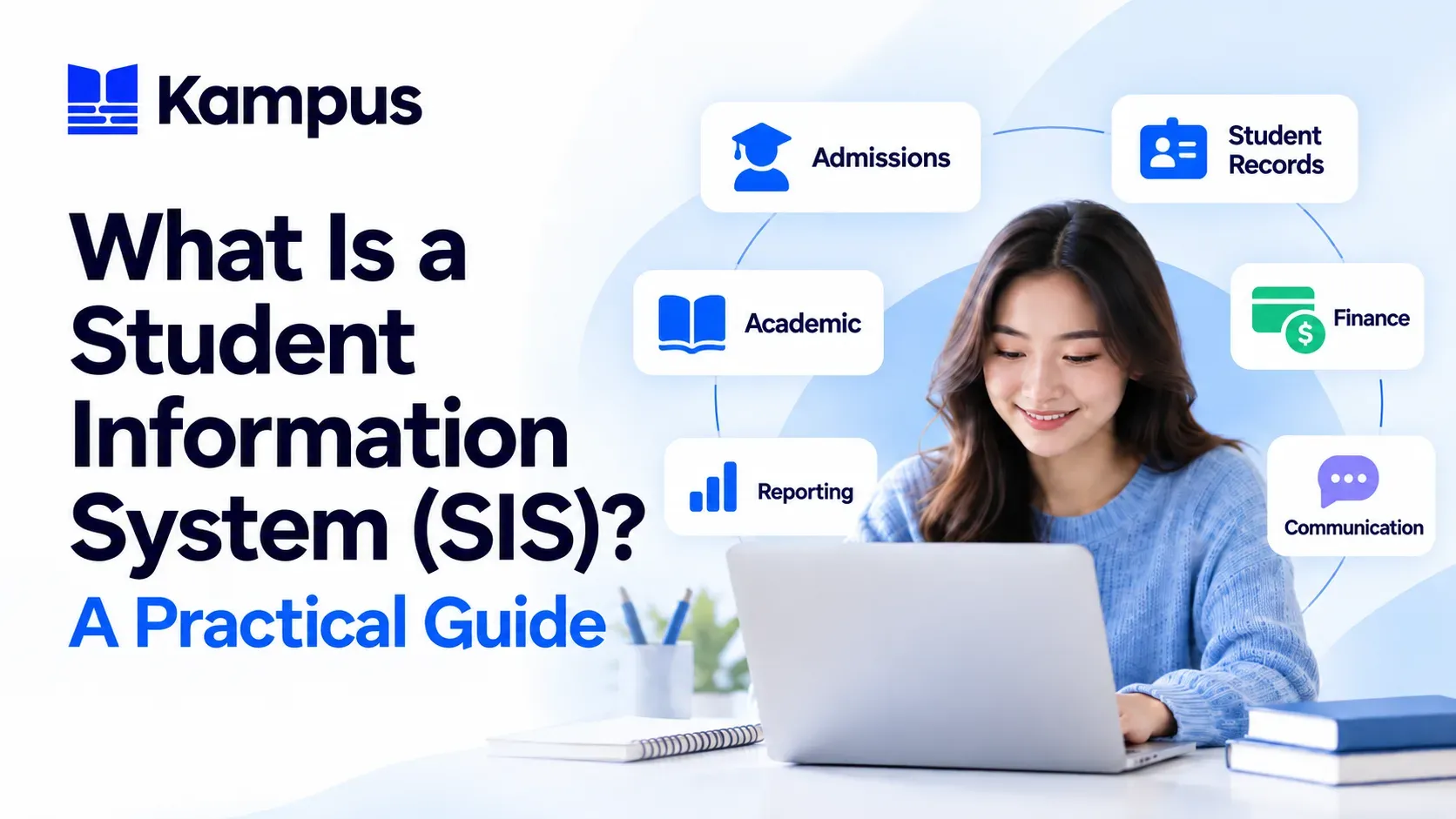
A modern SIS can support the journey from application and enrolment through academic administration, finance, timetabling and student self-service. The value comes from connecting these processes around the same student record instead of treating each department as a separate data island.
Kampus Axis is designed around this connected model. Its published product capabilities cover programme and curriculum management, admissions and enrolment, fee plans, timetable and scheduling, a student self-service portal, LMS connectivity, roles and permissions, audit logs and AI-ready connectivity.
1. Admissions and enrolment
Admissions is often the first place where student data enters an institution. A useful SIS should provide a structured way to manage applications and move applicants through the institution’s enrolment process.
In Kampus Axis, the admissions and enrolment pipeline supports configurable application workflows, offer letters, discount codes, payment links and a timestamped audit trail. The goal is to keep the transition from applicant to enrolled student inside the same operational system rather than rebuilding the record later in another tool.
2. Programme and curriculum management
Student records only make sense when they are connected to the correct programme, curriculum, academic period and module structure.
Kampus Axis includes programme and curriculum management with an approval workflow and curriculum version control. This allows institutions to maintain a historical academic structure while managing changes to programmes and module offerings over time.
3. Student fees and payments
Student finance is another area where disconnected systems can create duplicated work. An SIS can help by linking charges, invoices, receipts and payment status directly to the student record.
Kampus Axis includes a fee plan engine with multiple fee structures, invoicing, receipts, refund workflows and payment gateway integrations. Recent Axis releases have also added support for recording and invoicing payments outside standard tuition-fee workflows, including itemised invoices and student selection during invoice creation.
If fee management is a major part of your evaluation, the existing Student Information System Checklist provides a deeper set of questions to ask before selecting a platform.
4. Timetabling and attendance
Timetabling is more than placing events on a calendar. Education institutions need schedules that relate to programmes, terms, cohorts, rooms, staff and students.
Kampus Axis includes timetable planning with conflict detection for staff, rooms and students. Published Axis updates also include timetable publication history, student access to published timetable information, attendance capture for timetable sessions, bulk attendance marking and centralised attendance settings.
5. Student self-service
An SIS should not only serve administrators. A student-facing portal can give learners direct access to the information and actions that the institution chooses to make available.
Kampus Axis includes a branded student self-service portal with custom-domain support. Published Axis capabilities include student applications, fee payments and access to academic records, together with OTP-based login and configurable institutional branding.
6. Reporting and record discovery
Once student information is managed in one operational platform, staff need practical ways to retrieve and report on it.
Axis reporting capabilities include student and enrolment reports, student demographic reporting, academic catalogue and timetable insights, finance reporting layouts, application-wide record search and dashboard content based on user permissions and enabled features.
These capabilities were expanded in the July 2026 Axis changelog, which also introduced status indicators in search results and an active-enrolment dashboard visualisation.
7. LMS integration
Many institutions use an LMS for course delivery alongside an SIS for student administration. The important question is how the two systems exchange enrolment and student information.
Kampus Axis includes native bi-directional Moodle integration. Its published feature set covers automatic synchronisation of enrolments, withdrawals and module changes, student Moodle account management and visibility of LMS activity from within the SIS.
Axis can also work together with Kampus Wave, which provides learning management capabilities for courses, assessments, live classes, learner communication, progress tracking and professional exam delivery.
8. Roles, permissions and data isolation
Student information includes operational and personal data, so access control is a core SIS requirement.
Kampus Axis gives each institution its own dedicated database and supports custom roles with granular permissions. It also maintains timestamped audit logs for administrative actions. These controls are designed to keep institutional data separated and to restrict access according to each user’s assigned responsibilities.
9. AI-ready connectivity
An emerging SIS capability is the ability to connect authorised institutional workflows with compatible AI assistants without giving those assistants unrestricted database access.
Kampus Axis supports this through the Model Context Protocol. Axis MCP can expose approved tools and information to compatible AI applications while respecting authentication, institutional boundaries and user permissions.
The recent article Introducing Kampus Axis MCP explains how this works and outlines examples across admissions, student information, attendance, finance and institutional operations.
How is an SIS different from an LMS?
An SIS and an LMS solve different parts of the education technology stack.
The SIS is centred on student administration and institutional operations: applications, enrolments, student records, fees, academic structures, timetables and related administration. An LMS is centred on teaching and learning: course content, assignments, quizzes, grades, discussions, live classes and learner progress.
They can operate separately, but connecting them can reduce duplicate account and enrolment management. Kampus Axis can integrate with Moodle, while Kampus Wave provides a connected LMS option within the Kampus product suite.
What should you look for when choosing an SIS?
The best evaluation criteria are the ones that match your institution’s real workflows. Instead of asking only whether a vendor has “admissions”, “finance” or “timetabling”, examine how deeply those areas are implemented and how they interact.
- Can admissions workflows reflect your institution’s process?
- Can the platform represent your actual fee structures?
- Does curriculum management preserve versions and approvals?
- Does timetabling understand academic structures and conflicts?
- Can students complete appropriate tasks through self-service?
- How are roles, permissions and audit logs implemented?
- How does the SIS integrate with your LMS?
- Can the system support future integrations without fragmenting your data again?
For a more detailed evaluation framework, use the 12-question SIS checklist before comparing vendors.
Where Kampus Axis fits
Kampus Axis is the Student Information System within the Kampus suite. It is built to manage the operational side of the student lifecycle in one platform, with published capabilities spanning admissions, enrolments, programme and curriculum management, fee plans, timetabling, student self-service, reporting, LMS integration, permissions and auditability.
Institutions can explore the complete Kampus Axis feature set or book a demonstration to evaluate the platform against their own requirements.